Why Immigration Firms Lose Clients Between Enquiry and Engagement (and How to Fix It)

Let me show you where most immigration firms are quietly losing money. And I promise, it is not where you would guess.

It is not your marketing. It is not the quality of your advice. It is that little gap between someone reaching out and someone in your firm actually replying. That is where good clients slip away. Usually to the firm down the road that simply got back to them first.

EzyMigrate was built to close that gap. But before we talk about the fix, let me show you how big the leak really is. Honestly, the numbers surprised even me.

The leak nobody is watching

Here is the thing most firms forget. When someone enquires about their visa, they are almost never talking to just you. Nearly half of people reach out to a few firms at once, and the first one to reply helpfully usually wins them. So your enquiry is really a race. Most firms just do not realise they are in one.

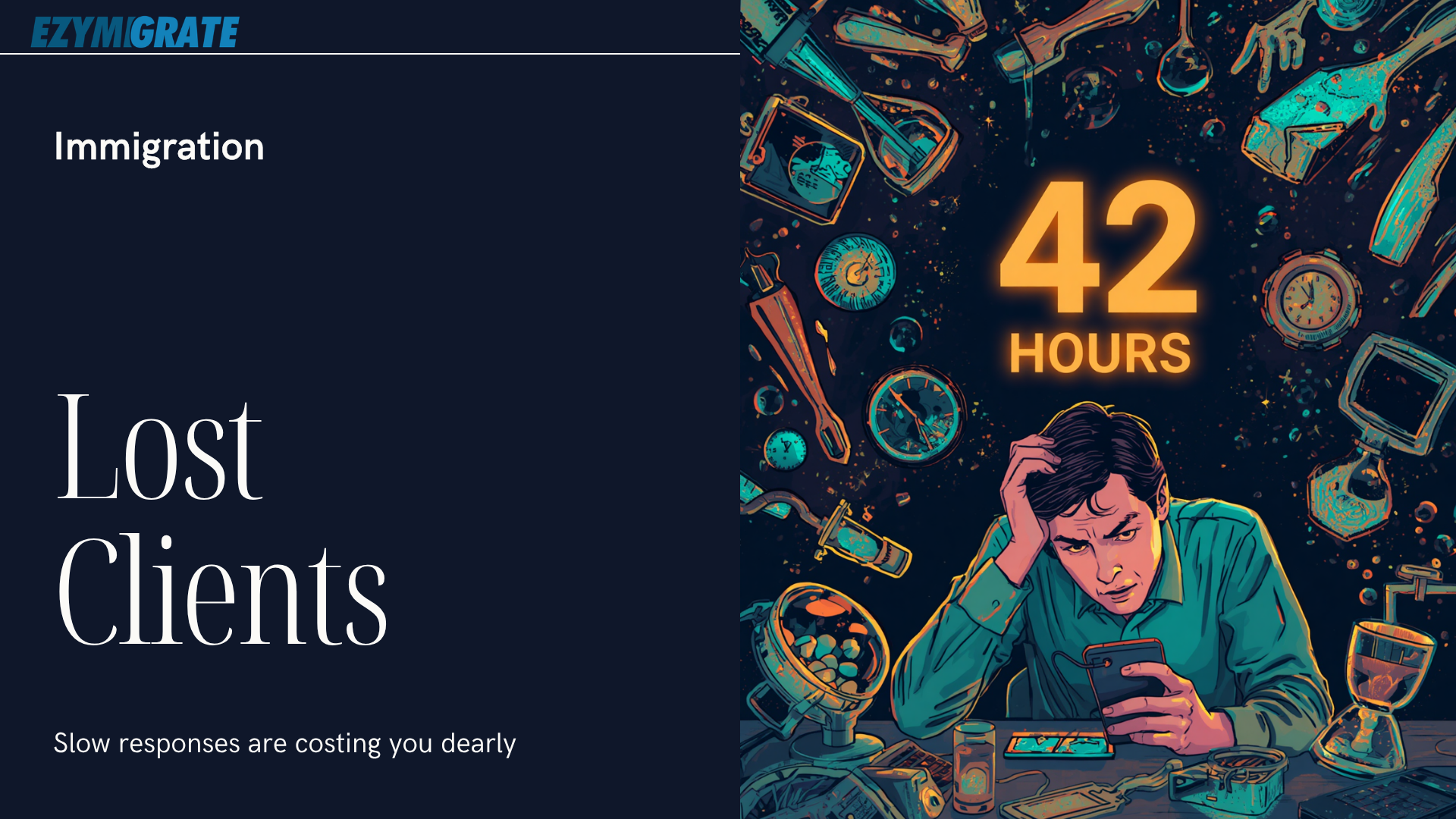
And they are slow. Painfully slow. The average first reply to a new enquiry takes around 42 hours. Sit with that for a second. Nearly two full days of silence after someone nervously typed out their situation and hit send. By then they have already spoken to two other firms, and maybe signed with one of them.

And the cost of being slow is huge. People contacted within five minutes are 21 times more likely to become clients than people contacted just thirty minutes later. Not 21 percent more. Twenty-one times more. Speed is not a nice extra here. It is the main thing standing between you and a signed client.

It gets worse. A lot of enquiries get no reply at all. Research on legal intake found that 42 percent of people never hear back after their first enquiry. You paid to bring these people in, and nearly half of them are met with total silence.

Why this happens to good firms

Now here is the part I really want you to hear. This does not mean you are bad at your job. It happens to brilliant, busy, caring firms all the time. And the reasons are almost always the same few things.

Enquiries come in at all hours. Nobody is watching the inbox at 9pm when a worried applicant finally sits down to send one. Your team is buried in active casework, actually doing the advice clients are paying for, so a fresh enquiry just sits there for hours. And most firms run intake through a messy mix of email threads and sticky notes, which is exactly why enquiries fall through the cracks. Nobody really owns the follow-up, so it quietly becomes nobody’s job.

Then there is follow-up, or the lack of it. Most people need more than one nudge before they commit. But most firms give up after one try, if they manage even that. Firms without proper tracking lose up to 25 percent of their leads to weak follow-up alone. The person was interested. They just needed a second message that never came.

So what actually fixes it?

Here is the good news. This is not a talent problem. It is a systems problem. And systems problems have clean, doable fixes. Here is what closing the leak really takes.

Reply straight away, day or night. The moment an enquiry lands, that person should hear something back, even after hours. This matters more than anything else, because so many enquiries come in outside office hours from first-time enquirers, and after-hours cover is just not optional anymore. A quick, warm reply the second someone reaches out is how you win the race.

Make sure every enquiry has an owner. No enquiry should land in a shared inbox where it can quietly be forgotten. It needs to go somewhere with a clear owner and an automatic trail. This is where a real system earns its keep. Firms that use a CRM to track and follow up convert 47 percent more leads than firms doing it by hand.
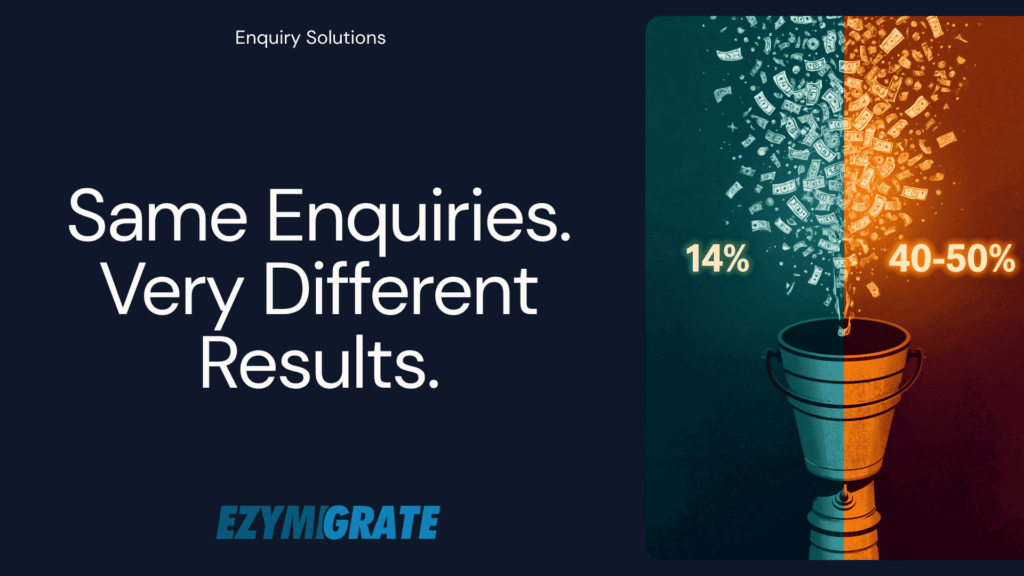
Follow up more than once, without relying on memory. Since most people need a few touches before they engage, your follow-up should run on its own. This is the difference between the average firm signing around 14 percent of enquiries and the best firms signing 40 to 50 percent. Same enquiries. Completely different results. The gap is almost all down to speed and follow-up.

How EzyMigrate closes the gap

This is exactly what EzyMigrate is built for. It is a CRM and case management platform made specifically for licensed immigration advisers, and it treats that enquiry-to-engagement moment as the make-or-break moment it really is.

When an enquiry comes in, EzyMigrate grabs it straight away and puts it into your pipeline as a real, owned contact. Nothing sits forgotten in an inbox. With EzyAI, our built-in AI layer, that enquiry can get an instant, helpful reply the second it arrives, even at midnight, so you become the firm that answered first instead of the firm that answered two days later. And the follow-up runs automatically, gently nudging the person through several touches so warm enquiries do not go cold while your team is busy doing the real immigration work.

You are not working harder. You have just stopped leaking the clients you already paid to attract.

The bottom line

You probably do not have an enquiry problem. You most likely have plenty of people raising their hands. What you have is a gap between their hand going up and someone in your firm replying. And that gap is where your money is quietly draining away.

Close it, and you do not need a single extra lead to grow. You just need to stop losing the ones you already have.

That is what EzyMigrate is for. It captures every enquiry the moment it lands, EzyAI replies instantly and keeps warm prospects engaged around the clock, and the follow-up runs on its own so nothing slips while your team is busy. One system to make sure the client who reached out to you actually becomes the client who signs with you.

Frequently asked questions

As close to instant as you can manage. People contacted within five minutes convert far better than those reached even thirty minutes later, and the gap only grows the longer you wait. Aim for an immediate acknowledgement the moment an enquiry lands, at any hour.

It is often worse for small firms, because there are fewer people to watch the inbox. That is exactly why automation helps small teams the most. It lets a handful of people respond and follow up like a much bigger firm, without hiring anyone.

A fast, helpful reply beats a slow one every single time. The goal is not to replace your advice. It is to make the person feel looked after in those crucial first moments, so they stay with you until a human takes over.

Response time. Speeding up how fast you reply to new enquiries is consistently the highest-return change a firm can make, and it usually costs nothing extra in marketing.

Not at all. It handles the instant capture, the first reply, and the repetitive follow-up, so your team’s time goes to the actual advice and casework that only a person can do.
Managing Compliance and Deadlines Across Multiple Countries Without the Chaos

If you run an immigration practice across more than one country, you already know the feeling. That quiet fear in the back of your mind about the one deadline that might slip. Because in immigration, a missed date is not a small admin slip you can laugh off later. It can cost a client their case, their status, and their trust in you.

EzyMigrate was built for advisers who live with exactly that pressure, juggling New Zealand, Australia, Canada, and the USA, each with its own rules, its own forms, and its own clocks ticking away. Let me walk you through why multi-country work gets so chaotic, and how to bring it back under control.

Why the stakes are so high

Let me be honest about what is really on the line here, because it is easy to lose sight of when you are buried in the day-to-day.

In immigration, deadlines do not bend. Miss one, and you can trigger a request for evidence that pushes a case back by months, or worse, a denial that wrecks someone’s plans to live or work in the country. When an authority sends a request for evidence, the window to reply is strict, often just thirty to ninety days, and missing it usually means the application is denied and treated as abandoned. The client loses their fees, has to start over, and if their status hung on that application, they can fall out of status completely.

That is the weight sitting behind every single date in your calendar. As one immigration software team put it, generic to-do tools just do not get that missing a deadline might mean a family stays apart or someone loses their shot at permanent residency. This is not like missing a meeting. For the people who trusted you, the fallout can change their whole life.

Why more countries means more chaos

Now take all that pressure and multiply it across several countries at once. This is where even great practices start to feel underwater, and it is not their fault.

Every country has its own forms, its own deadlines tied to visa expiries and priority dates, and its own processing times that change without warning. Keeping one country’s rules straight is hard enough. Holding four sets of rules in your head, and knowing which one applies to which client on which day, is a whole different level of hard.

Immigration cases also run for years, not weeks. A client might start with a work visa, come back later for residency, then eventually citizenship, and each stage builds on the one before it. So you are not tracking a few dates. You are tracking a whole web of them, across lots of clients, several countries, and many years, all at the same time.

And when all of that lives in spreadsheets, email threads, and someone’s memory, it gets fragile fast. Compliance ends up leaning too heavily on the memory of overworked advisers. That is exactly the setup where something eventually slips through.

How to bring it back under control

Here is the encouraging bit. This chaos is completely fixable. And no, it does not mean working longer hours or hiring an army. It means letting the right system do the watching for you. Here is what that looks like.

Get every date into one place that watches them for you. The single biggest fix is pulling every deadline, across every country and every case, into one system that actively keeps an eye on them, instead of waiting for you to check. Good software has built-in alerts for visa expiries, filing deadlines, and rule changes, so your team can stay ahead instead of firefighting. The system should be tapping you on the shoulder before a date arrives, not after.

Use software that actually understands immigration. Generic calendars do not know what a priority date is, or why an RFE window is sacred. A platform built for immigration maps these milestones properly, so the reminders mean something and nothing important gets treated like a random to-do.

Keep every document and detail in one secure home. Immigration throws off a mountain of sensitive paperwork, passports, financial records, supporting evidence, all with strict privacy needs. Keeping it all in one place with proper access controls and an audit trail means faster filings and fewer mistakes, especially when deadlines are tight or the case is complex. No more digging through email chains in the middle of a filing crunch.

Give the whole team one shared view. When advisers, paralegals, and admin all work in the same system, everyone can see where a case is at, which closes the communication gaps where things usually go wrong. Shared visibility and built-in reminders are what stop deadlines being missed when several people are touching the same case.

How EzyMigrate keeps you in control

This is the exact problem EzyMigrate was built to solve. It is a case management platform made for licensed immigration advisers working across New Zealand, Australia, Canada, and the USA, so multi-country complexity is not some afterthought. It is the whole point of the thing.

EzyMigrate keeps every case, every document, and every deadline in one secure place, and it watches those dates for you across all your countries, so you get a heads-up well before anything is due, instead of finding out too late. Because it understands immigration workflows specifically, the reminders are meaningful, not just noise. And with EzyAI, our built-in AI layer, the everyday load gets lighter still. It can handle client updates and chase the missing documents that so often hold a case up, so your team is not manually herding paperwork while the clock ticks. Because your whole team works in the same system, nothing rests on one person remembering one date. The system remembers, so your people can focus on the advice.

The result is simple. The chaos of juggling four countries stops living in your head and your spreadsheets, and starts living in a system built to hold it.

The bottom line

Multi-country immigration work will always be complex. That is never going away. But complex and chaotic are two different things. Complex is just the nature of the work. Chaos is what happens when you try to manage all that complexity with memory and spreadsheets instead of a proper system.

Put the right platform in place, and you keep all the complexity but lose the chaos, and that constant low hum of fear about the one date that might slip.

That platform is EzyMigrate. Built for immigration advisers, watching every deadline across every country, with EzyAI quietly handling the updates and document chasing in the background. One secure home for your cases, your documents, and your peace of mind.

Frequently asked questions

It depends on the deadline, but the consequences are often serious. A request for evidence that goes unanswered can get the application denied and treated as abandoned, costing the client their fees and possibly their status. And unlike a lot of other fields, extensions are rarely granted. That is why staying ahead of deadlines matters so much.

Not really. Generic tools do not understand immigration-specific milestones like priority dates or RFE windows, so they treat a case-critical deadline like any old reminder. Immigration-specific software maps these properly and flags them with the right urgency.

Complexity is part of the deal. Chaos is not. The complexity comes from each country’s different rules and timelines, which will always exist. The chaos comes from managing all of that by hand. A system built for multi-country work takes away the chaos while keeping you on top of the complexity.

It means everything sits in one secure, access-controlled spot with an audit trail. Nothing gets lost in email threads, retrieval is fast when you are up against a deadline, and confidentiality is properly protected. That directly cuts down the mistakes that cause delays.

No. It takes the burden of remembering and tracking off your plate, so your expertise goes where it should, on the actual advice and case strategy, instead of being a human calendar for dozens of moving deadlines.